


 6:01
6:01Helix 2.5: zero-shot full-body behaviors in 30 real homes
@coreylynch · 31 views · 2026-09-17
HumanoidFigure AIHelix
6:01 0:32
0:32 0:27
0:27 0:05
0:05 2:02
2:02 1:02
1:02 0:39
0:39 0:09
0:09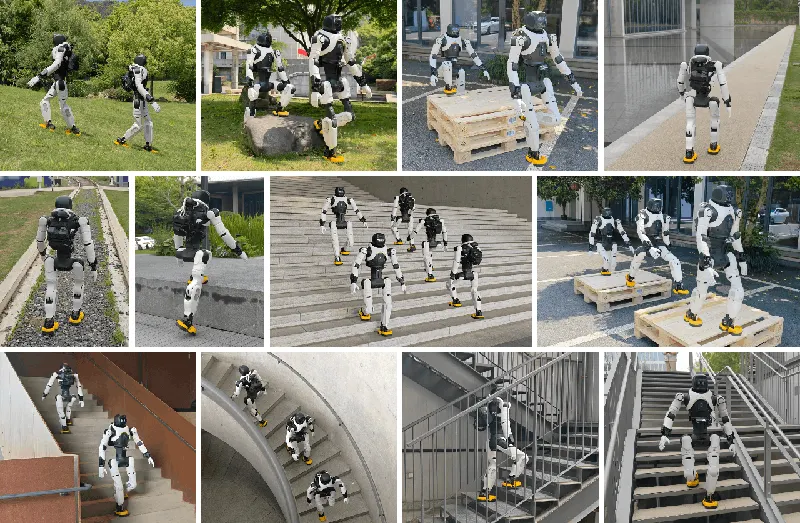
Extending humanoid traversal to the open world is key to practical deployment in human environments, but remains challenging. The robot must use vision to ensure safe and reliable foot placement on heterogeneous terrain under highly dynamic motion, while producing coordinated, natural whole-body behaviors. We propose SSR, an efficient end-to-end framework for egocentric vision-based humanoid traversal that jointly learns these capabilities. SSR introduces imagined foothold guidance, which learns to model forthcoming swing-foot contacts and evaluates their support to guide pre-touchdown swings toward stable regions, reducing edge slips. It further employs equivariant latent-space symmetry augmentation to efficiently induce bilateral coordination under high-dimensional visual observations, and uses terrain-specific multi-discriminator motion priors to encourage human-like behavior across scenes. Extensive experiments show that SSR achieves safe, stable, and high-quality locomotion on diverse real-world terrains, including stairs with varied structures and extreme challenges such as wide gaps and high platforms, while enabling reliable long-horizon traversal in open outdoor environments.
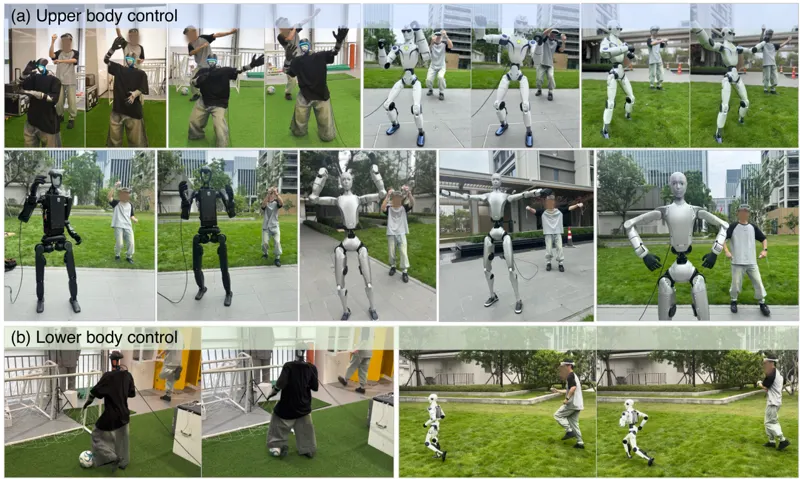
Scaling humanoid whole-body control toward general-purpose deployment requires large human motion corpora and training experience shared across robot bodies. Existing methods usually train one policy per robot, leaving motion experience isolated across embodiments. We introduce X-WBC, a cross-embodiment foundation framework that separates relatively shared human motion semantics from embodiment-specific physical execution. Human-centered command tokens align full human motion, robot reference motion, and sparse VR observations. A causal Transformer learns reusable temporal structure from mixed multi-robot rollouts, while lightweight robot-specific modules map the shared representation to each robot's proprioception and action space. Across nine simulated embodiments, external motions, and four real robots, experiments show that joint training improves tracking, the aligned representation supports consistent control across command sources, and the learned policy remains competitive beyond the training corpus. These results support heterogeneous humanoids as joint data sources and establish cross-embodiment joint training as a practical route toward whole-body control foundation models.
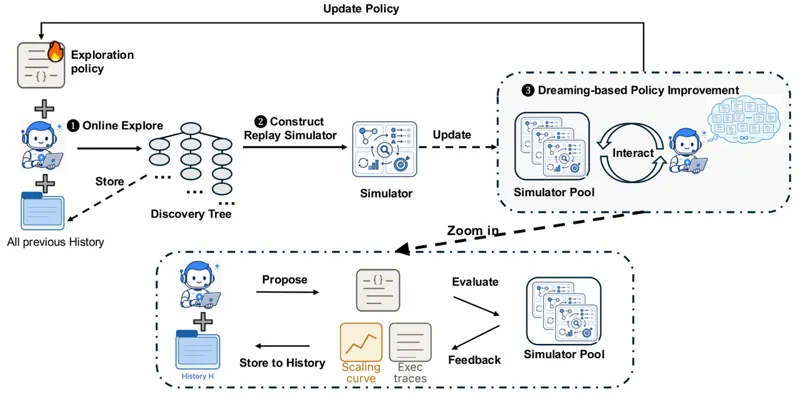
Recursive self-improvement is becoming increasingly vital for autonomous AI agents, where progress hinges on discovering high-value solutions across complex domains. The driver of this process is effective exploration, however, managing and improving exploration strategies remains a major bottleneck. Current systems face a fundamental dilemma: fixed strategies fail to adapt as search spaces scale, while online policy optimization requires navigating vast meta-search spaces under delayed and expensive feedback over long-horizon rollouts. We introduce {Dream-RSI}, a framework for scalable and recursively self-improving exploration. A lightweight orchestration layer makes exploration explicit and programmable while leaving the underlying coding agent unchanged. Our key insight is that accumulated discovery history can serve as a replay simulator over the realized search space. By performing dreaming in the replay simulator constructed from historical discovery trees, {Dream-RSI} secures immediate, low-cost off-policy feedback to evaluate and refine exploration policies without invoking repetitive, expensive online evaluations. The improved policy is subsequently redeployed online to drive further discovery, continuously expanding the simulator pool in a self-improving loop. Across algorithm engineering, mathematical optimization, and GPU kernel engineering, {Dream-RSI} achieves competitive or improved discovery quality while substantially reducing discovery cost in several settings.
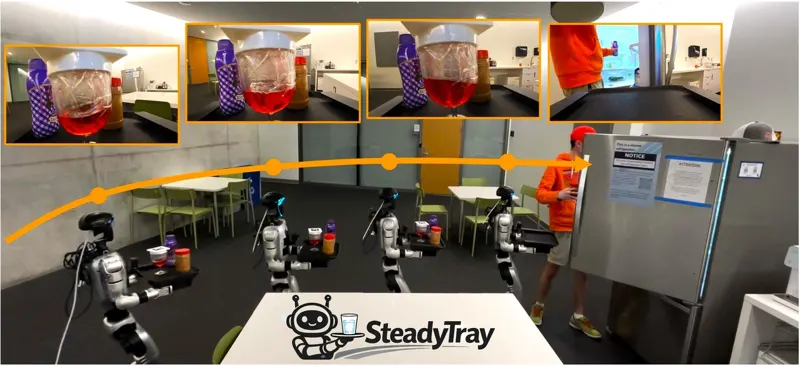
Stabilizing unsecured payloads against the inherent oscillations of dynamic bipedal locomotion remains a critical engineering bottleneck for humanoids in unstructured environments. To solve this, we introduce ReST-RL, a hierarchical reinforcement learning architecture that explicitly decouples locomotion from payload stabilization, evaluated via the SteadyTray benchmark. Rather than relying on monolithic end-to-end learning, our framework integrates a robust base locomotion policy with a dynamic residual module engineered to actively cancel gait-induced perturbations at the end-effector. This architectural separation ensures steady tray transport without degrading the underlying bipedal stability. In simulation, the residual design significantly outperforms end-to-end baselines in gait smoothness and orientation accuracy, achieving a 96.9% success rate in variable velocity tracking and 74.5% robustness against external force disturbances. Successfully deployed on the Unitree G1 humanoid hardware, this modular approach demonstrates highly reliable zero-shot sim-to-real generalization across various objects and external force disturbances.
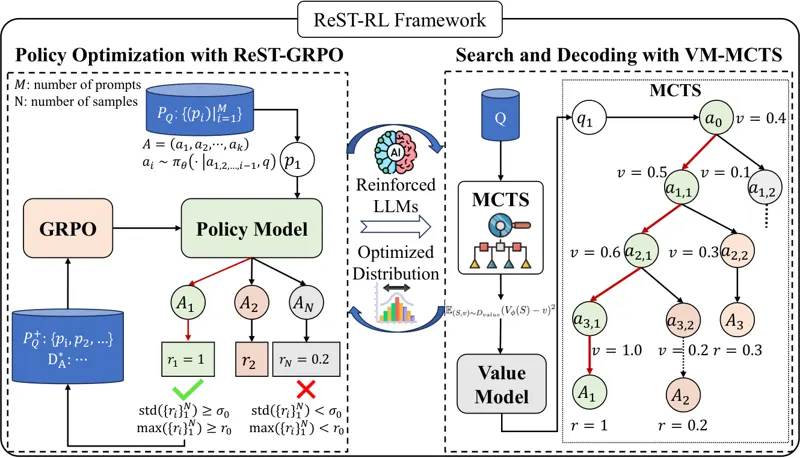
GRPO is the representative RL method for improving LLM reasoning, yet it only ever sees one sparse reward at the end of a whole trajectory: when the rewards inside a sampled group land close together, the group-relative advantage collapses into noise and the policy learns almost nothing. ReST-RL reconnects policy optimization and value-guided search into a single self-training pipeline. Stage one, ReST-GRPO, first filters out low-information prompts by reward standard deviation, then draws prefixes from each prompt's highest-reward trajectory under a discrete exponential distribution and uses them as fresh online-GRPO starting contexts. A selected prefix is context only; its suffix is re-sampled and optimized rather than imitated. Stage two, VM-MCTS, runs MCTS under the now-static policy to self-collect value targets and trains a value model that predicts expected terminal reward. At inference the same model both allocates the tree search through UCT and ranks completed candidates in a Best-of-N fashion, so search and verification share one state-value scale. On coding benchmarks including APPS, BigCodeBench and HumanEval, Qwen3-8B moves from 0.503 to 0.689 average. In matched policy-value controls, ReST-GRPO + VM-MCTS reaches 0.642 on APPS-500 while GRPO + VM-MCTS reaches only 0.538, so the stage-one distributional shift survives value learning. End-to-end accounting puts ReST-GRPO at 1,752 GPU-hours against 2,080 for GRPO, hitting a 9% gain in 71 hours instead of 207. A value model trained only on code trajectories also transfers to MATH, Omni-MATH and GPQA-Diamond without target-domain tuning.
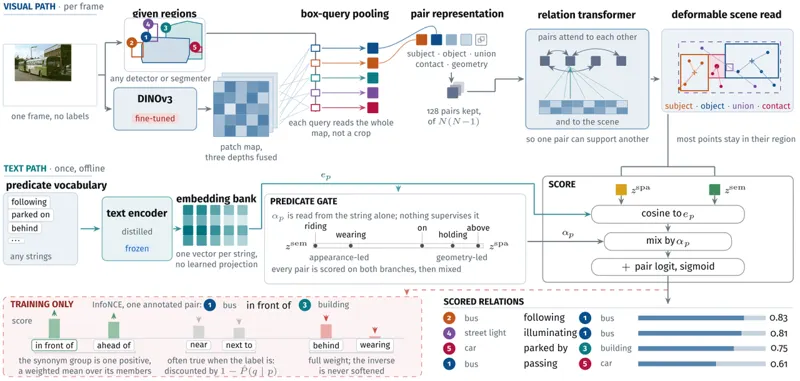
Open-vocabulary detection accepts any class list at inference, and promptable segmentation returns regions without class names: the taxonomy has left the model and become an input. Relation prediction has not. Scene-graph models are still trained and evaluated on the 50 or 56 predicates of one annotation style, their relation head conditioned on object labels and so tied to one detector. Three obstacles explain this, none primarily modelling: no relation corpus is both free-text and verified, a label-conditioned architecture cannot accept a vocabulary it was not trained on, and the standard metric rewards agreement with the training corpus, so a larger vocabulary scores as a regression. We present RelateAnything, a 53M-parameter model taking an image and regions from any source and returning scored relations over a predicate vocabulary supplied at inference as strings. Object labels are never an input, so the region source can change without retraining, and the vocabulary is a bank of text embeddings, not a learned classifier. It runs at 20 ms/frame. Training over 19,103 predicates requires positive-unlabeled supervision and a text encoder that separates antonyms, which contrastive encoders embed at cosine 0.95. To supply the supervision we build RA-4M, 474k images and 4.3M relations over 10,102 free-text predicates, generated against numbered box markers and geometrically verified. To measure it we build OV-SGG-Bench, six axes scored across datasets that the priors standard recall rewards cannot satisfy. On three cross-dataset benchmarks and a fourth zero-shot, RelateAnything has 2.3-3.5x the mean recall of the strongest open-vocabulary method of comparable scale, margins that survive a real detector, and leads a 3B-VLM scene-graph model on both metrics at under 2% of its parameters. In-domain measurement overstates transfer gains ~5x. Model, corpus and benchmark are public.

A deep read of TypeSafe's first System One Model: three question primitives, the economics of parallel calls, confidence-gated routing, eval caveats, eight jagged edges, and the OpenJev local repro.

The run book behind PaperRoute: mechanics before art, engine and look as separate threads, Blender driven by headless Python, Meshy for faces, review renders driving iteration, 39 tracked hours.

Meta distills compliance expertise into 200+ structured files, splits what the agent knows from how it reasons via recipes, and compiles expert fixes into regression-tested edits, no model retraining.
 Hardware★11855%
Next generation open-source KVM over IP for $69
JetKVM
 Gadgets★6145%
A lightweight EDC with an M390 blade that can cut through almost anything...
Hacksmith Industries
 3D Printing★20614%
4 Toolheads | 5s Toolhead Swap | Multi-Material | Low Waste | 500 mm/s Speed | Smart Calibration | Auto Filament System | App Control
Snapmaker
 Hardware★10290%
No noise to disturb sleep with Active Noise Cancellation and Snore Masking System. Sleep better with AI brainwave audio. Ultra comfort.
soundcore
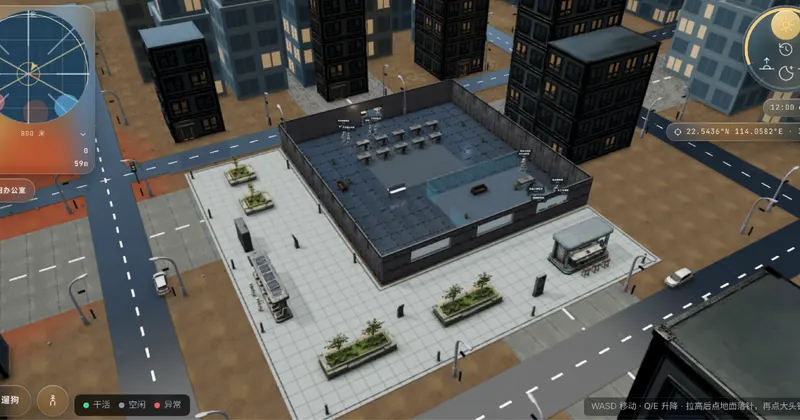
A 100 km 3D city that opens in seconds — the digital twin of the AI agents that build this site: crawling, blogs, papers, industry and investment analysis.
100km city · opens in seconds · Live task stream · Agent-maintained
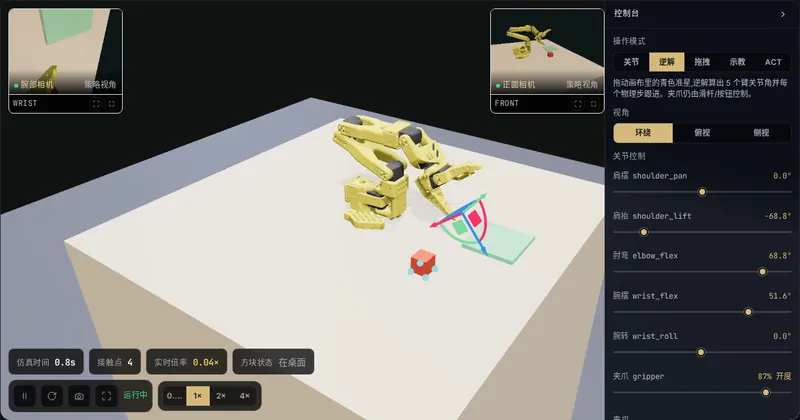
An SO-101 6-DoF arm running MuJoCo physics in your browser: joint teleoperation, IK end-effector dragging and gripper pick-and-place into a basket. No install.
MuJoCo WASM physics · SO-101 · 6 DoF · Contacts / telemetry HUD
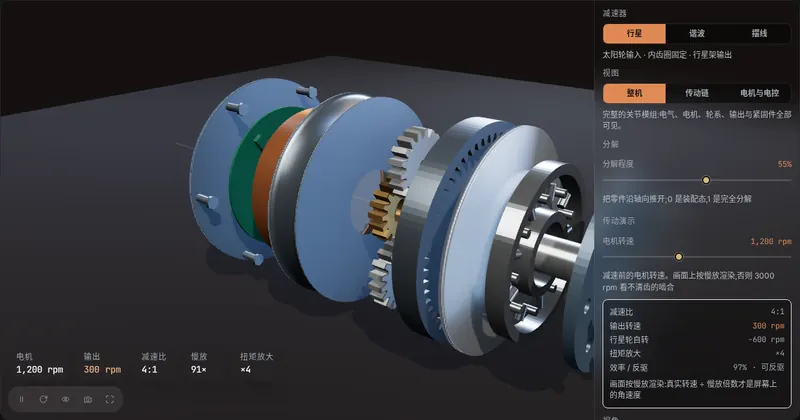
Take a humanoid joint module apart layer by layer: brushless motor, magnetic encoder, planetary / harmonic / cycloidal drive and output flange. Switch architectures on one page — exploded view plus analytic kinematics.
Three gearbox types · Planetary / harmonic / cycloidal · Analytic kinematics · explode

Matcha-TTS mixed zh/en speech synthesis: server-side synthesis with sentence-streamed playback and full-article read-aloud for papers and blogs. Sign-in required.
Matcha-TTS · server-side · Mixed zh / en · Full-article read-aloud
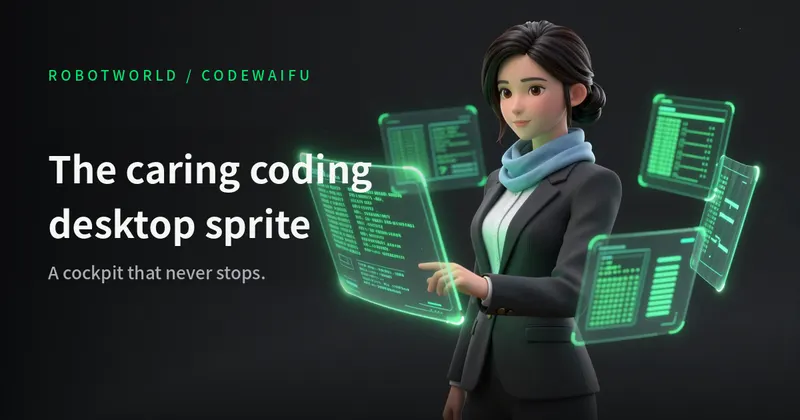
A caring coding sprite on your desktop and a cockpit that never stops: the work resumes itself after a crash or a reboot. Every coding terminal, ssh session and local shell in one tree, every start, finish and permission request reported in time. Open source, one-line install.
Your caring coding desktop sprite · Resumes after crash & reboot · First-rate terminal / ssh / shell
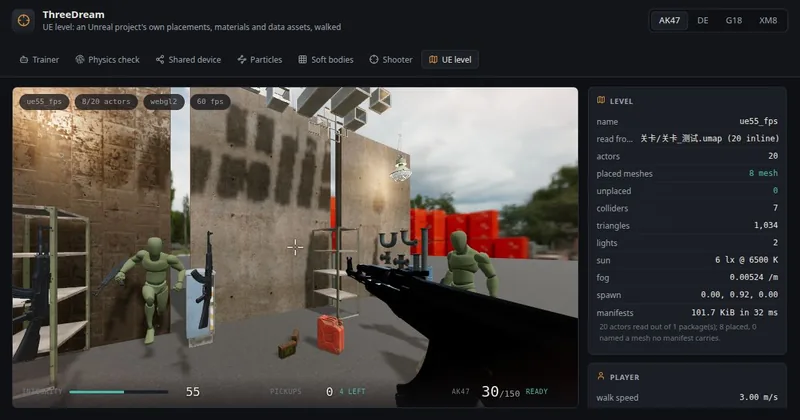
The first Unreal-adapted physics-AI kernel for the browser: a deterministic ECS on a fixed timestep, a WebGPU scale layer driving 100k particles and 20k soft-body nodes, a policy-gradient learner training live in the page, and UE 5.5 levels playing smoothly in three.js.
UE 5.5 levels, read live · 100k particles · WebGPU · in-page RL training


